

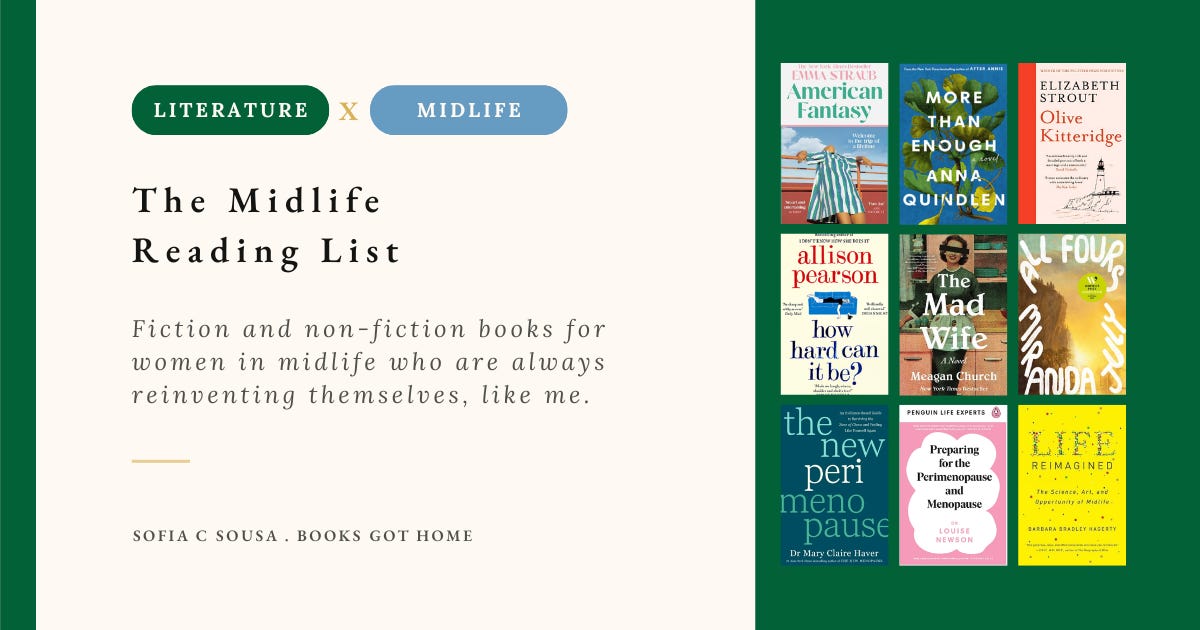
The Midlife Reading List
Fiction and non-fiction books for women in midlife who are always reinventing themselves, like me. English | Português

Introduction
I’m approaching fifty. Entering midlife can bring up feelings like worry, anxiety, calm, or even confidence. As a woman, mother, wife, author, and psychologist, I’ve come to realise that midlife is one of the most misunderstood chapters of a woman’s life. This week, I wrote an essay about midlife: you can read it here.
The most common narratives about midlife usually gravitate around two extreme poles: the one in which heavily loaded words abound, which makes the woman feel trapped or immersed in negativity (for example: crisis; decline; collapse; invisibility; devaluation; disregard), and the one stuffed with toxic positivity that dismisses or ignores bio-psychological issues instead of acknowledging them (for example: good vibes only; everything happens for a reason; happiness is a choice; stop being so negative; look on the bright side).
There are a couple of books that address midlife in a constructive, objective way, without being fluffy or moralistic. Books that make a difference by changing paradigms and deconstructing stereotypes and prejudice.
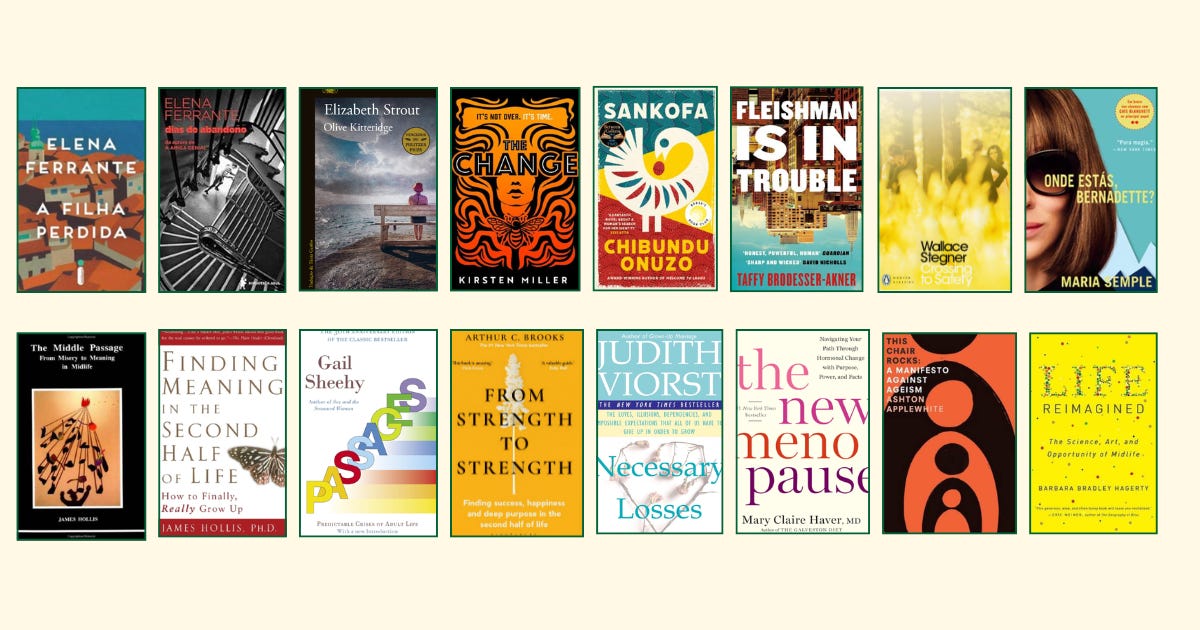
In this publication, I’m sharing personal, non-exhaustive reading suggestions that helped me to know myself better, gain objective insights, and broaden my horizons on midlife. I’ll start with novels, then move to nonfiction books.
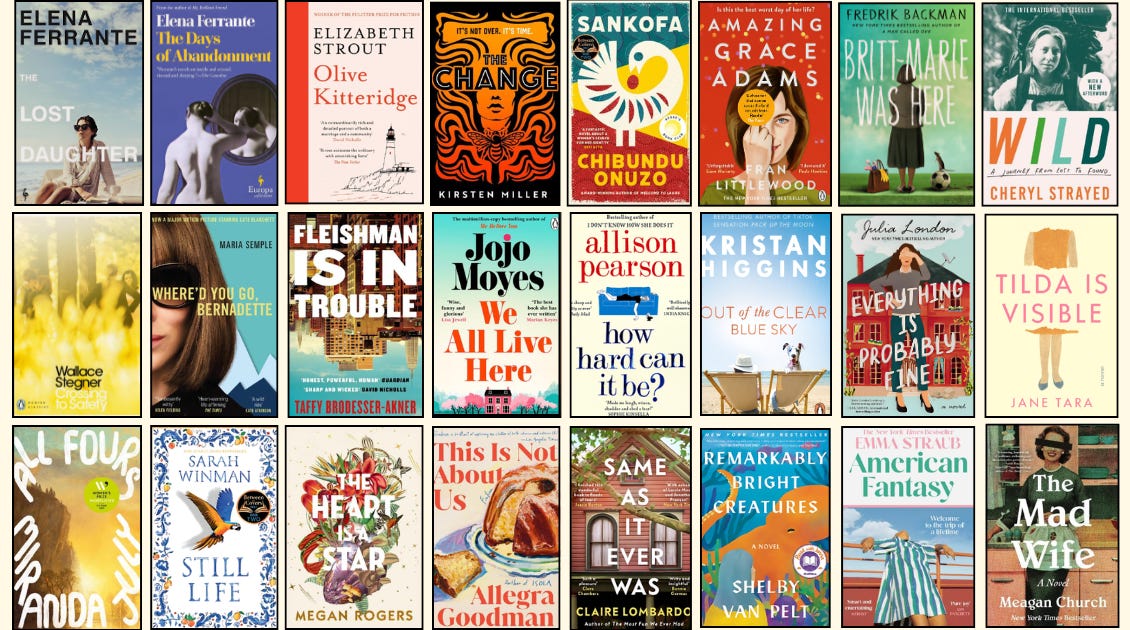
I. The Fiction: Reinventing Yourself (Again)
All these novels have two things in common: courageous, fanny, messy women who are approaching midlife or are at the heart of it. In some books, this topic can be found in the smallest details, which is great because they facilitate linking themes and consequent reflection.
I.
The Days of Abandonment, by Elena Ferrante
The synopsis: At 38, a woman is left by her husband without warning or explanation. What follows is raw, intense, and psychologically sharp. Almost uncomfortable to read, and completely impossible to put down. Ferrante doesn’t hold back in showing what happens when a woman’s life falls apart and she has to discover what’s left. This novel asks who you are outside your roles, except that the question arrives uninvited here.
This is the perfect book if you’re facing a sudden change, like a divorce, a loss, or an identity that fell apart before you were ready, and you need someone to tell the truth about what that feels like from the inside.
Available in PT/BR.
II.
The Lost Daughter, by Elena Ferrante
The synopsis: Shorter and quieter than her Neapolitan novels, and in some ways more precise.
A woman alone on holiday watches a young mother on the beach. Slowly, she begins to unfold the choices she made and their cost to her. This novel explores ambivalence, the things we carry and let go, and the unique “guilt” of being a woman who wanted more than she was expected to want.
This is the perfect book if you’re reflecting on the choices you’ve made, not with regret, but with the honest curiosity that comes from finally having enough distance to see them clearly.
Available in PT/BR.
III.
Olive Kitteridge, by Elizabeth Strout
The synopsis: Olive is a complicated woman. She can be difficult, self-aware in a desarming way, and often wrong about things she’s sure of. She is also one of the most fully human characters in contemporary fiction, and I personally love her. Strout’s portrait of a woman moving through her fifties, sixties, and beyond is proof that becoming yourself never really finishes. Which turns out to be the whole point.
This is the perfect book if you’re tired of stories where women finally arrive. Olive never really arrives. She keeps going, imperfect and honest, and that turns out to be enough.
Available in PT.
IV.
The synopsis: This out-of-the-box thriller in which three perimenopausal women solve a series of murders, and the symptoms we’re taught to fear become, in Miller’s hands, something closer to superpowers. Hot flashes make them stronger. Brain fog lets them connect with the dead. The underlying argument is that the things midlife does to a woman’s body are a transformation, full stop. This is one of the most original novels about this life chapter that I’ve read.
This is the perfect book if you want a story that takes the strange, inconvenient, and sometimes frustrating parts of midlife and turns them into something valuable.
V.
The synopsis: This is a quieter, more intimate story. The main character is in her early fifties, recently divorced, her child has moved out, and her mother has just died. Suddenly, she doesn’t know who she is outside her usual roles, so she sets out to find herself. What she finds isn’t what she expected, and that’s the point. Onuzo writes about identity and belonging with precise detail and warmth. This novel truly earns its ending.
This is the perfect book if you’re at that point in midlife when your roles have faded, and you’re left wondering who you are now.
VI.
Fleishman Is in Trouble, by Taffy Brodesser-Akner
The synopsis: This book starts as a divorce novel and ends as something else entirely. I won’t spoil the twist, but the real question is: whose inner life do we value, and whose do we ignore? If you’ve ever had the feeling of being a side character in your own story, this book will hit home.
VII.
Crossing to Safety, by Wallace Stegner
The synopsis: This novel is about two couples, a long friendship, and what remains when life changes. No dramatic revelations, just the slow, careful accumulation of a life and what it means to look back on it with clarity. I read it in two sittings and thought about it for weeks.
This is the perfect book if you’re in a long marriage or friendship and are starting to wonder what it all means, with the clarity that comes with time.
VIII.
Where’d You Go, Bernadette, by Maria Semple
The synopsis: This book is funny and surprisingly moving. It follows a brilliant woman who gradually fades into her own life until she stops showing up altogether. The story feels light and reads quickly, but it asks a serious question: what happens to a woman’s sense of self when she spends years being everything for everyone else? And what does it take to find herself again?
This is the perfect book if you need a reminder that disappearing into your roles has a cost, and that finding yourself again is long overdue.
IX.
We All Live Here, by Jojo Moyes
The synopsis: After her husband leaves her for a younger woman, the main character suddenly has to share her home with her elderly father and her adult children. As she deals with the chaos and humor of her new life, she starts to wonder who she really is when, for once, nobody needs her help.
This is the perfect book if you feel like you’re everyone’s emotional support human and need to remember that you’re a person, too.
X.
Remarkably Bright Creatures, by Shelby Van Pelt
The synopsis: Tova, a widow in her seventies, works the night shift at an aquarium where she strikes up an unlikely friendship with a giant Pacific octopus. A story about old secrets, late-life connection, and the realisation that it is never too late for answers…or for something new.
This is the perfect book if you appreciate a quirky perspective and believe that connection can come from the most unexpected places.
XI.
Britt-Marie Was Here, by Fredrik Backman
The synopsis: After her husband of forty years cheats on her, the socially awkward, tidiness-obsessed Britt-Marie finds herself in a dying small town, coaching a youth football team. A novel about what happens when someone who has made herself very small finally decides to take up space.
This is the perfect book if you have ever felt defined entirely by your habits and your partner’s needs, and wonder what would happen if you simply walked out the door.
XII.
Everything is Probably Fine, by Julia London
The synopsis: Lorna Lott has always been the reliable one: efficient, driven, and quietly furious. When a workplace incident lands her in a mandatory thirty-day wellness retreat, she is forced to confront the family wound she has spent forty years managing around: her sister’s addiction and the guilt that never quite went away. A story about what we carry when we have always been the one who holds it together.
This is the perfect book if you are the stable one in your family and have never quite been allowed to fall apart.
XIV.
How Hard Can It Be?, by Allison Pearson
The synopsis: The sequel to I Don’t Know How She Does It. Kate Reddy is back, now navigating perimenopause, teenage children, aging parents, and the particular indignity of trying to re-enter the workforce in her fifties. Funny, sharp, and painfully recognisable.
This is the perfect book if you need a laugh-out-loud reminder that you are not the only one Googling “early-onset dementia vs. menopause brain.”
XV.
The Heart is a Star, by Megan Rogers
The synopsis: Layla Byrnes is an anaesthetist juggling a disintegrating marriage, young children, and a complicated love affair, and her unstable mother, who repeatedly threatens to take her own life. When her mother calls just before Christmas with a secret about Layla’s much-loved father, Layla rushes to her childhood home on the wild west coast of Tasmania. What she finds will upend everything she thought she knew about herself. An Australian debut of rare emotional precision.
This is the perfect book if you have ever loved a parent so completely that discovering the truth about them feels like losing the ground beneath your feet.
XVI.
Out of the Clear Blue Sky, by Kristan Higgins
The synopsis: Lillie is a nurse whose husband leaves her just as their only child heads to college. Faced with an empty nest and a broken heart at the same time, she has to figure out who she is without the titles of wife or active mother. Warm, funny, and surprisingly moving.
This is the perfect book if you are facing an empty nest and are ready (finally) to reclaim your own life.
XVII.
Same As It Ever Was, by Claire Lombardo
The synopsis: A deep, sprawling portrait of Julia Price, a woman navigating the echoes of a past mistake while her adult son prepares to marry. A novel about the long game of motherhood, the archaeology of a marriage, and the parts of ourselves we cannot quite leave behind.
This is the perfect book if… you love a character-driven dive into the hidden complexity of long-term relationships and the way the past keeps surfacing in the present.
XVII.
The synopsis: A beautiful, sweeping novel that begins in WWII Italy and follows a chosen family across decades. A celebration of art, love, and the kind of friendship that becomes indistinguishable from family. One of the most generous novels written in recent years.
This is the perfect book if… you want to get entirely lost in a story that proves life is a work of art at any age.
XVIII.
Amazing Grace Adams, by Fran Littlewood
The synopsis: Grace Adams is having a very bad day. She is stuck in traffic, her daughter won’t speak to her, and she is perimenopausal. She decides to get out of the car and walk across London to win back her life. Furious, funny, and deeply humane.
This is the perfect book if you have ever felt one minor inconvenience away from leaving everything behind and starting on foot.
XIX.
Tilda Is Visible, by Jane Tara
The synopsis: Tilda Finch, fifty-two and recently divorced, wakes one morning to find part of herself has literally disappeared. Her doctor delivers the diagnosis: invisibility disorder, a condition affecting millions of women over forty. Tilda refuses to simply fade away, and what follows is a funny, wise, and surprisingly moving investigation into why women disappear, and what it actually takes to be seen again. Australian magical realism at its warmest.
This is the perfect book if you have ever walked into a room and felt entirely unseen and want a story that insists you take up space.
XX.
The synopsis: After the death of her mother and the collapse of her marriage, twenty-six-year-old Cheryl makes the impulsive decision to hike eleven hundred miles of the Pacific Crest Trail alone, with no experience and too-small boots. Not really a book about hiking. Entirely a book about what we do when we have run out of other options.
This is the perfect book if… you feel lost in your own life and need a visceral reminder that the only way out of the wreckage is to keep putting one foot in front of the other.
XXI.
American Fantasy, by Emma Straub
The synopsis: Annie, newly divorced and with an empty nest, boards a four-day cruise ship reluctantly, one hosting a famous nineties boy band and three thousand devoted fans who have loved them for thirty years. Once a diehard fan herself, Annie feels out of place among the bedazzled T-shirts. But when the music begins, something long-buried stirs. A novel about nostalgia, aging, fame, and the things we loved as teenagers that turn out to still matter enormously.
This is the perfect book if you have ever given yourself fully to loving something - a band, a book, an era - and want a story that says that kind of love was never embarrassing. It was always who you were.
XXII.
More Than Enough, by Anna Quindlen
The synopsis: High school English teacher Polly Goodman’s close-knit book club gives her a DNA ancestry test as a joke. When the results match her with a stranger, she cannot stop combing through her family history for answers. And when it seems the circle of four may become three, Polly learns just how much the right friendships can change the shape of a life. Warm, wise, and written with Quindlen’s characteristic precision about women’s interior lives.
This is the perfect book if friendship is the bedrock of your life and you want a novel that takes that seriously.
XXIII.
This Is Not About Us, Allegra Goodman
The synopsis: When the youngest of the three Rubinstein sisters dies, a misunderstanding over an apple cake at the deathbed sends the other two into a decade of stubborn silence. A multigenerational portrait of a Jewish American family: divorces, career setbacks, bat mitzvahs, and the complicated, begrudging, stubborn love that outlasts any argument. Structured as linked stories, each from a different family member’s perspective.
This is the perfect book if your family of origin is messy, loving, and sometimes impossible and you want a novel that holds all of that at once without resolving it too neatly.
XXIV.
The synopsis: A forty-five-year-old artist sets off on a solo road trip, then spends it in a motel room, obsessively redecorating and confronting her own desire, her creative life, and the particular madness of perimenopause. Daring, strange, and completely honest about the parts of midlife that most fiction is still afraid to name.
This is the perfect book if you want an unflinching, slightly unhinged, and entirely truthful look at what perimenopause actually does to a person’s sense of self and what might come out the other side.
XXV.
The Mad Wife: A Novel, by Meagan Church
The synopsis: In the 1960s, a devoted wife’s perimenopausal symptoms - brain fog and newfound independence - are branded as "madness." She must fight a prejudiced medical system and a controlling husband to reclaim her autonomy.
This is the perfect book if you’ve ever felt like your symptoms were being dismissed by the medical establishment and you want to read a powerful, atmospheric story about a woman fighting to reclaim her voice and her life.
The Non-Fiction: Expert-Led Guides & Evidence-Based Research
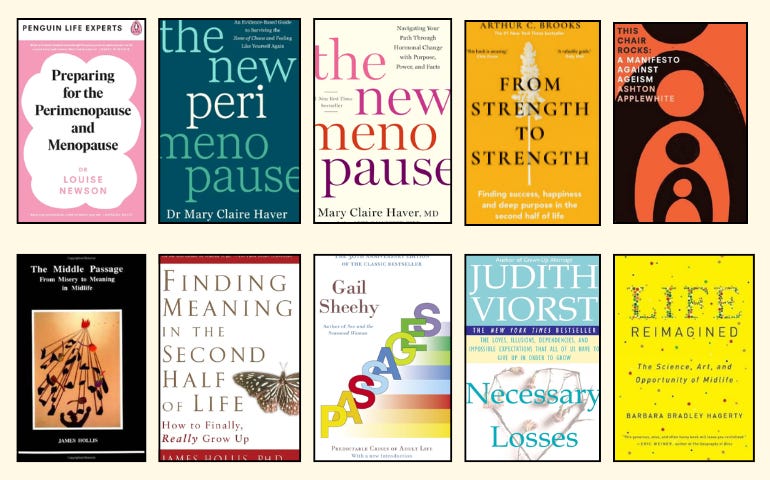
While the novels allowed me to feel what so many women experience in midlife, these non-fiction books helped me better, and more objectively, understand it. These aren’t self-help, motivational books with empty slogans. They’re serious, based on research, and written by trusted authors.
I.
The Middle Passage, by James Hollis
A Jungian analyst who argues, rigorously and convincingly, that midlife disruption is an invitation worth accepting. Dense in places, but worth the effort. One of the most psychologically honest books I know about what this chapter actually asks of us. Hollis doesn’t promise resolution. He offers something better: clarity about the questions worth asking.
This is the perfect book if you’re done with easy answers and ready for the real questions, starting with who you actually are underneath the life you’ve built.
II.
Finding Meaning in the Second Half of Life, by James Hollis
This is a more accessible companion to The Middle Passage and may be a better starting point if Jungian psychology is new to you.
Hollis addresses the questions that surface in midlife directly: what do I really want, what am I still carrying that was never mine, and what would it mean to actually live my own life? I found myself underlining almost every other page.
This is the perfect book if The Middle Passage feels like too steep an entry point, or if you want something that reads like a conversation.
III.
Written in 1976 and still so relevant!
Sheehy was one of the first writers to map adult life as a series of predictable passages, exploring the idea that identity is not fixed at 30 but keeps shifting, keeps asking to be renegotiated.
This is the perfect book if you want to understand why this chapter feels the way it does: a predictable, navigable passage that millions of women have moved through before you, and that has nothing to do with personal failing.
IV.
From Strength to Strength, by Arthur Brooks
A Harvard social scientist explores reinvention, the shift from fluid to crystallised intelligence, and why the second half of life can be more interesting. The book is backed by solid research and written with empathy and warmth.
This is the perfect book if you need the data behind the hope, if ‘it gets better’ only makes sense when someone can show you why.
V.
Necessary Losses, by Judith Viorst
On everything we give up as we grow: roles, illusions, relationships, and younger versions of ourselves.
Viorst, a psychoanalyst, writes about loss with care and tenderness. This book is for anyone who has begun to understand that becoming yourself requires letting go of what no longer serves you, and for anyone who needs help letting go.
VI.
The New Menopause, by Dr. Mary Claire Haver
A board-certified OB/GYN and menopause specialist who has spent her career doing what the medical establishment largely failed to do: take women’s symptoms seriously, explain them clearly, and offer real options.
This is a comprehensive, science-backed guide to everything that happens during perimenopause and beyond: hormones, sleep, brain fog, mood, bone health, heart health, and more. It reads like a conversation with the doctor you always wished you had.
This is the perfect book if you’re tired of being told your symptoms are just stress or anxiety, and you want someone with real credentials to explain what’s happening in your body and what you can do about it.
VII.
This Chair Rocks, by Ashton Applewhite
A sharp, well-researched look at ageism, especially the kind we’ve absorbed without realising it. Applewhite is funny and direct, and her chapter on how society treats women who are no longer young but not yet finished is essential reading, alongside everything else on the list.
This is the perfect book if you’ve caught yourself thinking things about older women that you’d never want anyone to think about you, and you’re ready to look at where those thoughts came from.
VIII.
Life Reimagined, by Barbara Bradley Hagerty
A journalist who spent years reporting on the neuroscience and psychology of midlife. What she found: the people who handle this chapter well are the ones who get curious about it. Readable, grounded, and genuinely hopeful without asking you to pretend everything is fine.
This is the perfect book if you’re curious about what’s coming or if you want to feel that.
IX.
The New Perimenopause, by Dr. Mary Claire Haver
The synopsis: A comprehensive, science-backed guide to perimenopause and menopause from one of the most trusted voices in women’s hormonal health. Moves decisively away from “grin and bear it” and toward specific, actionable guidance on nutrition, hormones, sleep, and medical advocacy.
This is the perfect book if you are tired of being told it is just part of getting older and want real medical answers from someone who takes the question seriously.
X.
Preparing for the Perimenopause and Menopause, Dr. Louise Newson
The synopsis: A compact, clearly organised guide across eleven chapters, with brief case studies and practical suggestions. Ideal for a first encounter with the subject. It also includes a list of questions to bring to your doctor.
This is the perfect book if you want a reliable, no-fuss starting point and something concrete to put in your bag before your next appointment.
A note for bilingual readers
For those of you reading in Portuguese: unfortunately, only four books in this selection are translated into Portuguese. I’ll keep updating this list as new translations and/or great books appear.
If you’ve read any of these, I’d love to hear which one reached you at the right time. And if a book told the truth about midlife in a way that surprised you, please share in the comments. The best reading lists are always made together. Thank you!
Warmly,

Edição em Português
Lista de leitura para a meia-idade
Livros de ficção e de não ficção para mulheres que se aproximam da meia-idade ou já a vivenciam.
Introdução
Estou a aproximar-me dos cinquenta. Entrar na meia-idade pode trazer sentimentos como preocupação, ansiedade, calma ou até confiança.
Enquanto mulher, mãe, esposa, autora e psicóloga, cheguei à conclusão de que a meia-idade é um dos capítulos mais mal compreendidos da vida de uma mulher. Esta semana, escrevi um ensaio sobre a meia-idade: podes lê-lo clicando neste link.
As narrativas mais comuns sobre a meia-idade tendem a gravitar em torno de dois polos extremos: aquele em que abundam palavras pesadas, que fazem a mulher sentir-se presa ou mergulhada na negatividade (por exemplo: crise; declínio; colapso; invisibilidade; desvalorização; desconsideração), e aquele repleto de positividade tóxica que ignora ou minimiza as questões bio-psicológicas em vez de as reconhecer (por exemplo: boas energias apenas; tudo acontece por uma razão; a felicidade é uma escolha; deixa de ser tão negativa; vê o lado positivo das coisas).
Existem alguns livros que abordam a meia-idade de forma construtiva e objetiva, sem serem superficiais nem moralistas. Livros que fazem a diferença ao mudar paradigmas e ao desconstruir estereótipos e preconceitos.
Nesta publicação, partilho sugestões de leitura pessoais e não exaustivas que me ajudaram a conhecer-me melhor, a ganhar perspetivas mais objetivas e a alargar os meus horizontes sobre a meia-idade. Vou começar pelos livros de ficção e depois passarei para os de não ficção.
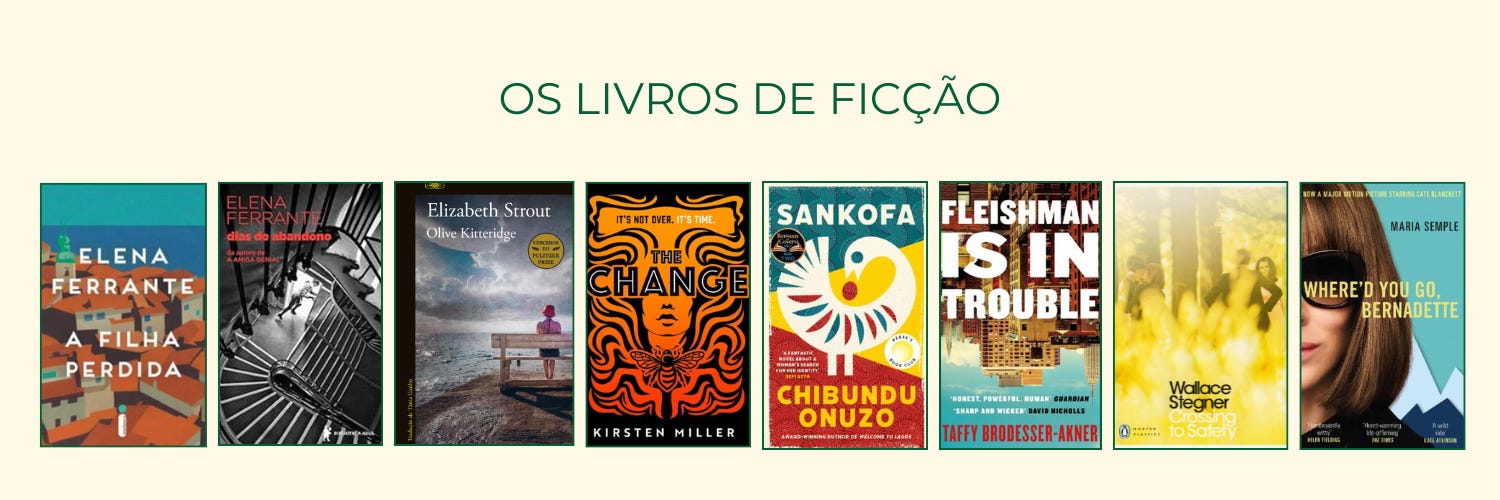
I.
Os Dias do Abandono, de Elena Ferrante
Aos 38 anos, uma mulher é abandonada pelo marido, sem aviso prévio nem explicação. O que se segue é cru e psicologicamente intenso. Quase desconfortável de ler, contudo, completamente impossível de largar. Ferrante não poupa na forma como mostra o que acontece quando a vida de uma mulher se desmorona e ela tem de descobrir o que resta. Este romance pergunta quem és fora dos teus papéis, mas aqui a pergunta chega sem ser convidada.
Este é o livro perfeito se estás a atravessar uma mudança súbita, como um divórcio, uma perda ou uma identidade que se desfez antes de estares pronta, e precisas que alguém diga a verdade sobre o que realmente se sente por dentro.
II.
A Filha Perdida, de Elena Ferrante
Mais curto e mais reservado do que os seus romances napolitanos e, em certos aspetos, mais preciso.
Uma mulher, sozinha, de férias, observa uma jovem mãe na praia. Lentamente, começa a desdobrar as escolhas que fez e o que lhe custaram. Este romance explora a ambivalência, as coisas que carregamos e as que largamos, e a “culpa” particular de ser uma mulher que quis mais do que se esperava dela.
Este é o livro perfeito se te encontras a refletir sobre as escolhas que fizeste, não com arrependimento, mas com a curiosidade honesta que vem da distância suficiente para as ver com clareza.
III.
Olive Kitteridge, de Elizabeth Strout
Olive é uma mulher complicada. Pode ser difícil, desconcertante e, muitas vezes, errada em relação a coisas de que tem a certeza. É também uma das personagens mais humanas da ficção contemporânea e eu, pessoalmente, adoro-a. O retrato que Strout faz de uma mulher que atravessa os seus cinquenta, sessenta anos e assim sucessivamente é a prova de que sermos fiéis a nós mesmas não tem prazo de validade.
Este é o livro perfeito se estás cansada de histórias em que as mulheres se rendem aos estereótipos. Olive, imperfeita e honesta, prova o contrário.
IV.
Um thriller fora da caixa em que três mulheres na perimenopausa resolvem uma série de crimes. Os sintomas que nos ensinaram a temer tornam-se, nas mãos de Miller, algo mais próximo de superpoderes. As afrontamentos tornam-nas mais fortes. O nevoeiro mental permite-lhes comunicar com os mortos. O argumento subjacente é que o que a meia-idade faz ao corpo de uma mulher é uma transformação, ponto final. Este é um dos romances mais originais sobre esta fase da vida que já li.
Este é o livro perfeito se queres uma história que pega nas partes estranhas, inconvenientes e, por vezes, frustrantes da meia-idade e as transforma em algo valioso.
V.
Esta é uma história mais reservada e íntima. A personagem principal tem pouco mais de cinquenta anos, está recentemente divorciada, o filho saiu de casa e a mãe acabou de morrer. De repente, já não sabe quem é fora dos seus papéis habituais e decide ir à sua procura. O que encontra não é o que esperava, e esse é precisamente o ponto. Onuzo escreve sobre identidade e pertença com precisão e calor humano.
Este é o livro perfeito se estás naquele momento da meia-idade em que os teus papéis se esvaziaram e ficas a perguntar-te quem és agora.
VI.
Fleishman Is in Trouble, de Taffy Brodesser-Akner
Este livro começa como um romance sobre divórcio e termina de forma completamente diferente. Não vou revelar o que acontece, mas a verdadeira questão é: valorizamos a vida interior de quem? E cuja vida interior é que ignoramos? Se já tiveste a sensação de ser uma personagem secundária na tua própria história, este livro vai fazer todo o sentido.
VII.
Crossing to Safety, de Wallace Stegner
Este romance é sobre dois casais, uma longa amizade e o que permanece quando a vida muda. Sem grandes revelações dramáticas, apenas a acumulação lenta e cuidadosa de uma vida e o que significa olhar para ela com clareza. Li-o em dois dias e fiquei a pensar nele durante semanas.
Este é o livro perfeito se estás num casamento longo ou numa amizade duradoura e começas a perguntar-te o que significa tudo isso, com a clareza que só o tempo traz.
VIII.
Where’d You Go, Bernadette, de Maria Semple
Este livro é divertido e surpreendentemente emotivo. Acompanha uma mulher brilhante que vai desaparecendo gradualmente na própria vida até deixar de aparecer de todo. A história parece leve e lê-se rapidamente, mas coloca uma pergunta séria: o que acontece ao sentido de si própria de uma mulher ao longo de anos em que passa a ser tudo para todos os outros? E o que é preciso para se encontrar de novo?
Este é o livro perfeito se precisas de um lembrete de que desaparecer dentro dos teus papéis tem um custo e que encontrares-te de novo já devia ter acontecido há muito tempo.
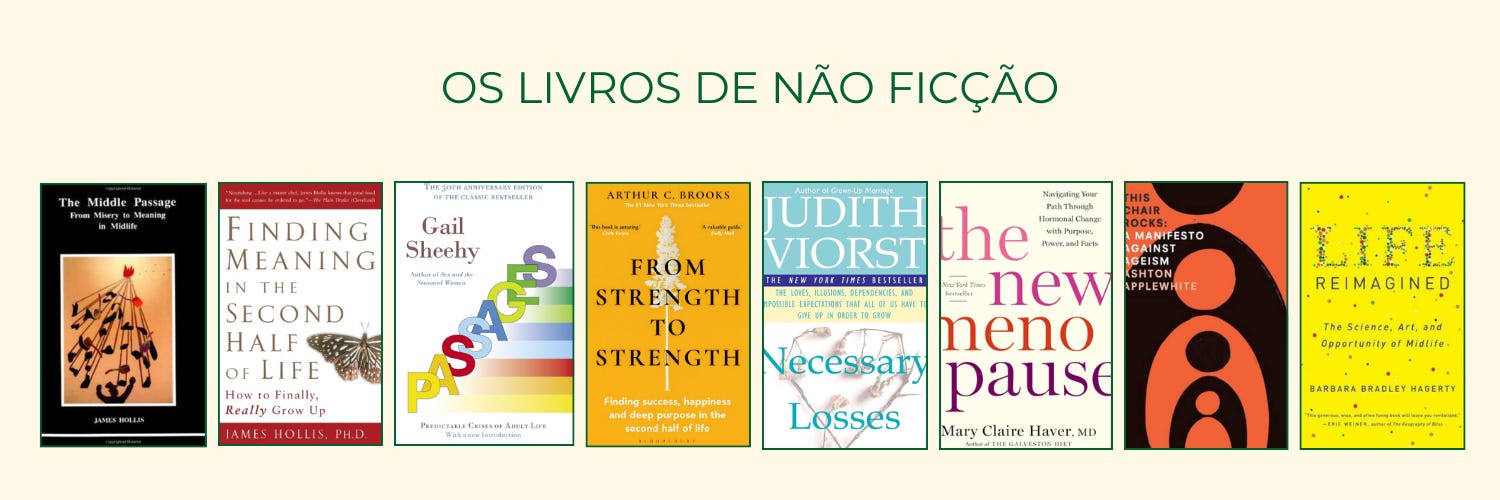
Enquanto os romances me permitiram sentir o que tantas mulheres vivem na meia-idade, estes livros de não-ficção ajudaram-me a compreendê-la de forma mais objetiva. Não são livros de autoajuda com slogans vazios. São sérios, baseados em investigação e escritos por autores de referência. Infelizmente, ainda não se encontram traduzidos para português.
I.
The Middle Passage, de James Hollis
Um analista junguiano que defende, com rigor e convicção, que a turbulência da meia-idade é um convite que vale a pena aceitar. Denso em alguns momentos, mas vale o esforço. Um dos livros psicologicamente mais honestos que conheço sobre o que este capítulo realmente nos pede. Hollis não promete resoluções. Oferece algo melhor: clareza sobre as perguntas que valem a pena fazer.
Este é o livro perfeito se já não tens paciência para respostas fáceis e estás pronta para as perguntas de fundo, a começar por quem és verdadeiramente por baixo da vida que construíste.
II.
Finding Meaning in the Second Half of Life, de James Hollis
Este é um acompanhamento mais acessível de The Middle Passage e pode ser um ponto de partida melhor se a psicologia junguiana é novidade para ti.
Hollis aborda diretamente as perguntas que surgem na meia-idade: o que é que eu realmente quero, o que é que ainda carrego que nunca foi meu e o que significaria viver verdadeiramente a minha própria vida? Encontrei-me a sublinhar quase todas as outras páginas.
Este é o livro perfeito se The Middle Passage parece um ponto de entrada demasiado exigente, ou se queres algo que se leia como uma conversa.
III.
Escrito em 1976 e ainda tão atual!
Sheehy foi uma das primeiras escritoras a mapear a vida adulta como uma série de passagens previsíveis, explorando a ideia de que a identidade não se fixa aos 30 anos, mas continua a mudar, a pedir para ser renegociada.
Este é o livro perfeito se te sentes sozinha e perdida: milhões de mulheres já atravessaram esta fase antes de ti e as turbulências nada têm a ver com falhar.
IV.
From Strength to Strength, de Arthur Brooks
Um cientista de Harvard explora a reinvenção, a transição da inteligência fluida para a cristalizada e por que razão a segunda metade da vida pode ser mais interessante. O livro é sustentado por investigação sólida e escrito com empatia.
Este é o livro perfeito se precisas dos dados por detrás da esperança, porque o “vai melhorar” só faz sentido quando alguém consegue mostrar-te porquê.
V.
Necessary Losses, de Judith Viorst
Sobre tudo o que vamos deixando para trás à medida que crescemos: papéis, ilusões, relações e versões mais jovens de nós próprias.
Viorst, psicanalista, escreve sobre a perda com cuidado e ternura. Este livro é para quem começou a perceber que tornarmo-nos nós próprias exige largar o que já não nos serve e para quem precisa de ajuda para o fazer.
VI.
The New Menopause, da Dra. Mary Claire Haver
Uma ginecologista-obstetra certificada e especialista em menopausa que passou a sua carreira a fazer o que o sistema médico largamente falhou em fazer: levar a sério os sintomas das mulheres, explicá-los com clareza e oferecer opções reais.
Este é um guia abrangente e baseado em evidências sobre tudo o que acontece durante a perimenopausa e mais além: hormonas, sono, nevoeiro mental, humor, saúde óssea, saúde cardiovascular e muito mais. Lê-se como uma conversa com uma médica irrepreensível.
Este é o livro perfeito se estás cansada de ouvir que os teus sintomas são apenas stress ou ansiedade e queres alguém com experiência para explicar o que se passa no teu corpo e o que podes fazer.
VII.
This Chair Rocks, de Ashton Applewhite
Uma análise aguçada e bem fundamentada sobre o envelhecimento, especialmente aquele que absorvemos sem nos apercebermos. Applewhite é divertida e direta, e o seu capítulo sobre como a sociedade trata as mulheres que já não são jovens é uma leitura essencial, a par de tudo o resto neste livro.
Este é o livro perfeito se já te apanhaste a pensar coisas sobre mulheres mais velhas que nunca gostavas que pensassem sobre ti e estás pronta para perceber de onde vêm esses pensamentos.
VIII.
Life Reimagined, de Barbara Bradley Hagerty
Uma jornalista que passou anos a investigar a neurociência e a psicologia da meia-idade. O que descobriu: as pessoas que melhor lidam com este novo capítulo de vida são aquelas que se mantêm informadas e curiosas para saberem mais. De leitura acessível, fundamentado e genuinamente esperançoso sem te pedir que finjas que está tudo bem.
Uma nota para leitoras bilingues
Para quem lê em português: infelizmente, apenas quatro livros desta seleção estão traduzidos para português. Continuarei a atualizar esta lista à medida que surjam novas traduções e/ou livros de autores/as com significativa experiência profissional.
Se já leste algum destes livros, adorava saber qual. E se um livro te disse a verdade sobre a meia-idade de uma forma que te surpreendeu, partilha nos comentários. As melhores listas de leitura fazem-se sempre em conjunto. Obrigada!
Com amizade,
